
|
Günter M. Ziegler elected President of FU Berlin
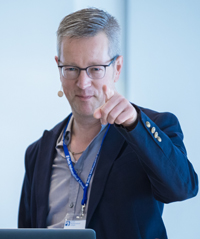
In the first ballot of votes cast, Ziegler received 39 of the 61 votes to succeed the long-term president of the FU, Prof. Dr. Peter-André Alt. Required was an absolute majority of 31 votes. Ziegler's main contender was Tanja Brühl, professor of political science at the Goethe University Frankfurt, who received 15 votes. The president of the FU Berlin is appointed by the Berlin Senate and the term of office lasts four years. Ziegler, who is currently the Chair of the Berlin Mathematical School, a professor of mathematics at the FU Berlin, and honorary professor at the TU Berlin, completed his PhD at MIT in 1987 and did his habilitation at the TU Berlin in 1992. From 1995 to 2011, he was professor of mathematics at the TU, before taking up his current position at the FU in 2011. Ziegler has been nationally and internationally recognized for the remarkable breadth of his mathematical knowledge, and for his services to research in the areas of discrete mathematics, geometry and topology. The German Research Foundation awarded Ziegler the Gerhard Hess Prize and the Leibniz Prize in 1994 and in 2001, respectively. He is a member of the board of the Berlin-Brandenburg Academy of Sciences, and a representative for the German National Academy of Sciences Leopoldina. In 2010, he was honored with an Advanced Grant from the European Research Council and in 2012, he was appointed to the first group of Fellows of the American Mathematical Society (AMS). In 2013, the mathematician was granted the Hector Science Award and appointed Fellow of the Hector Foundation. More recently, in 2017, Ziegler was awarded the Berlin Science Prize, and this year he received the Steele Prize for Mathematical Exposition (jointly with Martin Aigner) from the AMS. Ziegler, who has been acknowledged as an impressive communicator and praised for his reputation as a role model for scholars, young scientists and students alike, succeeds Prof. Dr. Alt, who was elected as President of the German Rectors' Conference (Hochschulrektorenkonferenz) on 24 April 2018, after acting as FU President since 2010. Everyone at the BMS would like to extend their hearty congratulations to Günter on his election as the new president of the FU Berlin!
Source: FU Berlin BMS Alumnus awarded Rollo Davidson Prize
This prize has been awarded annually since 1975 to young mathematicians for outstanding achievement in the field of probability theory. The members of the Rollo Davidson Trust at the University of Cambridge selected Nicolas "for his role in the development of the theory of paracontrolled distributions for singular stochastic partial differential equations and for advances in understanding of the Kardar-Parisi-Zhang equation". Previous prizewinners include Wendelin Werner und Alain-Sol Sznitman, who are former and current BMS Scientific Advisory Board members, respectively. Nicolas did his PhD at the HU Berlin under the supervision of Prof. Dr. Peter Imkeller, and graduated with summa cum laude in December 2013. He then became a postdoctoral researcher at the CEREMADE, a research centre within the Université Paris-Dauphine, before starting as a junior professor for stochastic analysis at the HU Berlin in January 2015. At the beginning of April 2018, he took up a Heisenberg researcher position at the Max Planck Institute for Mathematics in the Sciences (MPI MIS) in Leipzig. Congratulations Nicolas!
Written by S. E. Sutherland-Figini Source: University of Cambridge Statistical Laboratory BMS Summer School 2018HOMOTOPY THEORY SUMMER - BERLIN 2018 The event will focus on topics in homotopy theory and its applications to algebraic and arithmetic geometry, manifold theory and algebraic K-theory. There will be two consecutive weeks devoted to the following topics. Equivariant homotopy theory and K-theory Motivic homotopy groups of spheres III Each week is a workshop with an integrated summer school. In each week on Monday, Tuesday and on Wednesday afternoon we will have summer school lectures. These are primarily directed to PhD students and young PostDocs, but are open to all participants. There will also be accompanying tutorials and question sessions. 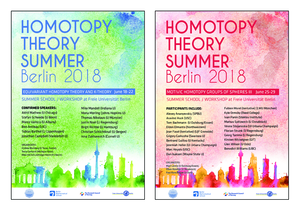 Summer School 1: Applications of topological cyclic homology and cyclotomic spectra Global homotopy theory Assembly maps and trace methods Summer School 2: An introduction to A^1 homotopy theory from an infinity-categorical viewpoint After the school part in each week there will be a workshop (Wednesday morning, Thursday, Friday). The summer school particpants are strongly encouraged to stay for the workshop as well. For up-to-date information about the workshop and the summer school please visit
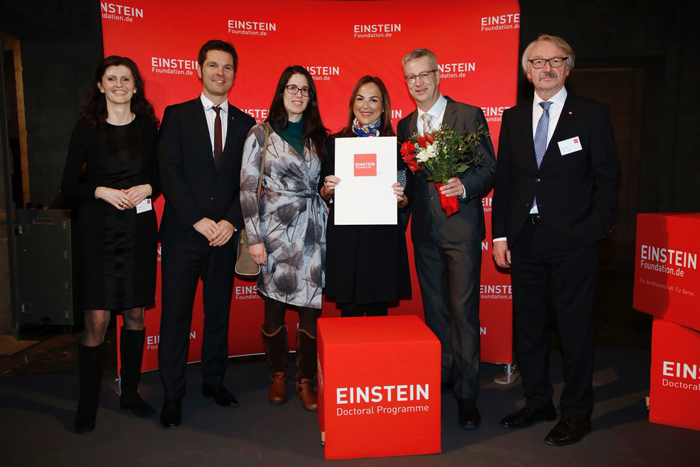
Registration and Application Senior researchers, i.e. those who completed their Ph.D. in or before the year 2015, may register for the summer school and the workshops here. Junior researchers should sign up at the BMS website and then apply via the separate application form under the link below. The deadline for applications with requests for funding expired March 7, 2018 and funding decisions have been taken. However until May 13 you can still apply for participation and since there may be cancellations by funded participants we still collect the data relevant for funding as well. Application Deadline: May 13, 2018 During the application you will be asked to upload two pdf-files. A scientific CV and a short letter of interest (half a page), where you should explain your motivation to participate in the event. You will also be asked to provide the contact information of one recommender. For participants with children of up to 6 years, there will be day care opportunities if requested well in advance in the application. Organizers • Andrew Blumberg (U Texas, Austin) Please direct scientific questions about the school to the organizers and administrative questions to This email address is being protected from spambots. You need JavaScript enabled to view it. Einstein Award for the BMSOn 18 January 2018, the Berlin Mathematical School was honored with an “Einstein Award for Doctoral Programmes“. This award recognizes outstanding highly structured doctoral programs at Berlin’s universities and at the “Charité – Universitätsmedizin Berlin“. It comes with substantial prize money earmarked for promoting and advancing research at a junior level as well as enhancing the international visibility of doctoral studies in Berlin. The award was conferred by the Einstein Foundation Berlin for the second year running and the prize-giving ceremony was held in Berlin’s Altes Stadthaus as part of the foundation’s traditional New Year Reception. The BMS received prize money in the sum of 75,000 euros per year for three years, and for the duration of this funding period each prizewinner can enjoy the distinction of being known as an “Einstein Doctoral Programme“. The financial component attached to this notable honor will considerably strengthen the BMS, in particular it will enable the optimal future development of two integral parts of its program. One part is the BMS Dirichlet Postdoctoral Fellowship Program, which is a two-year position offered to outstanding young PhD graduates, who want to pursue their own research in mathematics in one of the BMS Research Areas. The other is the BMS Alumni Program, which includes the BMS Alumni Day, an annual event designed to help alumni maintain a connection to the BMS, current students, fellow graduates and vice versa. The BMS was one of the three prizewinners chosen for their excellent doctoral programs. The other winners were the Berlin Graduate School Muslim Cultures and Societies, and the Graduate School of North American Studies. The Einstein Foundation Berlin was founded in 2009 by the State of Berlin. It promotes cutting-edge science and research, and strives to strengthen the city's reputation as one the world's leading research hubs.
Written by S. E. Sutherland-Figini Source: Einstein Foundation Berlin
BMS students successful at Dies Mathematicus 2017Several BMS students were winners at this year’s Dies Mathematicus at the TU Berlin. Prizes were given for the best degrees of the year and for the best presentations of the day. Phase I student Melanie Koser was one of three winners in the "Best Bachelor’s Degree" category. She presented her final thesis entitled "Zur kinetischen Formulierung skalarer Erhaltungsgleichungen". Among the three winners for the category "Best Master’s Degree" was her fellow Phase I student Jan Macdonald. He presented his thesis on "Bildklassifikation und die Scattering-Transformation - Woher Facebook & Co. wissen, was auf unseren Fotos zu sehen ist". In the category "Best Presentation", two out of the three winners were from the BMS: Phase II student Mones Raslan for the presentation of his master’s thesis entitled "Der Sprung vom Kontinuierlichen ins Diskrete: Repräsentationssysteme zur Lösung von partiellen Differentialgleichungen" and Martin Plonka for the presentation of his master’s thesis on "Differentialgleichungen in Netzwerken". Congratulations to all the winners!
Written by S. E. Sutherland-Figini Source: Dies Mathematicus
BMS Alumni awarded Tiburtius Prizes
Moritz was awarded the third Tiburtius Prize in the dissertation category for his outstanding PhD thesis entitled "Optimierungsmethoden in der Diskreten Geometrie". He did his PhD at the FU Berlin under the supervision of the current BMS Chair Prof. Günter M. Ziegler, and graduated with summa cum laude in 2016. Currently, Moritz is a postdoctoral researcher in Ziegler's Discrete Geometry research group at the FU Berlin. His award came with prize money in the sum of 1500 euros.
The State Conference of Rectors and Presidents of Berlin Universities (LKRP) annually awards three Tiburtius Prizes and three awards of recognition to recent PhD graduates from Berlin's universities for their outstanding doctoral theses. The prize-giving ceremony was held at the FU Berlin on 29 November 2017. Congratulations Moritz and Giuseppe! Written by S. E. Sutherland-Figini Source: FU Berlin
Two Berlin Science Prizes for the BMS
Ziegler, who is Chair of the Berlin Mathematical School, a professor of mathematics at the FU Berlin, and honorary professor at the TU Berlin, is nationally and internationally recognized for the remarkable breadth of his mathematical knowledge, and for his services to research in the areas of discrete mathematics, geometry and topology. Moreover, his reputation as a role model for young scientists, scholars and students precedes him. At the awarding ceremony, Mayor Müller acknowledged Ziegler as an excellent mathematician and impressive communicator, and President of the European Research Council (ERC) Prof. Dr. Jean-Pierre Bourguignon was proud to emphasize in his laudation that Ziegler is the second ERC laureate of this prestigious award. The Berlin Science Prize is awarded in recognition of outstanding achievements in science and research in Berlin. The prize money of 40,000 euros benefits the researcher’s institution, and one of its key uses is to support Berlin’s continued economic development. Ziegler’s other awards and honors include the Leibniz Prize (2001), the Communicator Award (2008), an ERC Advanced Grant (2010) and the Hector Science Award (2013). He is on the board of the Berlin-Brandenburg Academy of Sciences, is a member of the German National Academy of Sciences Leopoldina and the National Academy of Science and Engineering acatech, and he is also a Fellow of the American Mathematical Society. The awarding ceremony, which took place at Berlin’s “Rotes Rathaus“, included the Young Researcher Prize. This year it went to Dr. Myfanwy Evans, who is a BMS postdoctoral faculty member and Emmy Noether Research Group Leader at the TU Berlin. Evans, who hails from the Australian capital of Canberra, works at the interface between mathematics and physics. The prize, worth 10,000 euros, honors an innovative approach to research in a field that offers particular potential for Berlin’s scientific and economic future. Many congratulations to Günter and Myf! Written by S. E. Sutherland-Figini Source: FU Berlin
Career Day 2017: Scientific Life Balance
In the afternoon, there was a podium discussion with experts and decision-makers, who are active in the areas of science policy and research funding, and come from both the private and the academic sector. The aim was to provide an opportunity for additional discussion and suggestions at a more general level. Source: www.geo-x.net/career-day-2017/
First BMS - BGSMath Junior Meeting in BarcelonaIn their rich, diverse and international mathematical environments, the Berlin Mathematical School (BMS) and the Barcelona Graduate School of Mathematics (BGSMath) share the common goal of striving for excellence in their doctoral and postdoctoral training programs. To kick off the new collaboration between these two graduate schools, the first BMS - BGSMath Junior Meeting was held in Barcelona on 9 and 10 October 2017. The BMS and BGSMath have declared their intention to cooperate together in initiatives aimed at promoting the mobility of and exchange between students and faculty members by way of events such as the Junior Meeting; joint summer schools; mutual visits by advanced students and postdocs of each institution; and other scientific activities. The ultimate goal is to create strong scientific exchange, strengthen research collaboration between the respective math communities, and enhance the multicultural environment of both graduate schools.
Written by S. E. Sutherland-Figini Sources: BMS Phase II student’s 3D models are winners
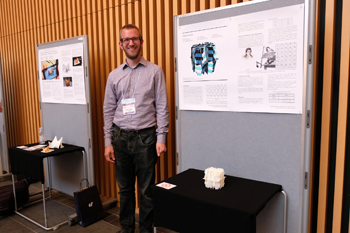
Created using sturdy, metallic-looking paper, the cut-outs for the models can be produced in large numbers using a laser cutting technique. The models are then put together by the users themselves and depict mathematical geometries with so-called multiple coverings. These are geometric analogies to the weaving process used in the production of cloth. By introducing multi-coverings, the models become both more stable and mathematically interesting. The models presented depict platonic solids, double covered, but the method can be applied to any geometrical model. Potential customers for Double Cover’s winning idea include teachers, science workshop organizers and private individuals. The other team members are the former BMS vice chair and head of the Mathematical Geometry Processing group Prof. Dr. Konrad Polthier, technical staff member Ulrich Reitebuch and student assistant Kevin Guo. The “Research to Market Challenge” is a competition for research-based product and business ideas and is open to members or alumni of the FU Berlin, among others. As well as prize money in the sum of 1500 euros, the team has been offered the chance to take part in a one-day workshop on business model development, coaching on how to successfully present their idea, and personal feedback by experts. No sooner had Martin accepted this prize with his team on 18 July 2017, than he and some members of his research group were awarded with another prize! On 10 August 2017 in Tokyo, Japan, the winners of this year’s Asian Digital Modeling Contest (ADMC) were announced: Martin, Konrad, and Ulrich were jointly awarded one of the two ADMC2017 Awards for Excellence for their model “Chladni Towers”.
As a member of the Mathematical Geometry Processing group at the FU Berlin, Martin is currently working on his PhD under the supervision of the former BMS vice chair Prof. Dr. Konrad Polthier. Martin's research interests include the acquisition of point sets via 3D-scanning as well as their processing. With regards to efficiency, he is interested in nearest-neighbor algorithms and corresponding data structures. Many congratulations to Martin and the other members of his team for their success! |
 On Wednesday 2 May 2018, the extended Academic Senate (Erweiterter Akademischer Senat) voted in favour of
 BMS alumni
  Giuseppe received an honorable award in recognition of his doctoral dissertation entitled "Singular SPDEs and Related Topics". He completed his PhD under the supervision of BMS faculty member Prof. Dr.
 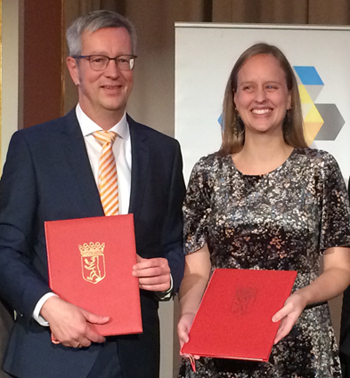 On 7 November 2017,
 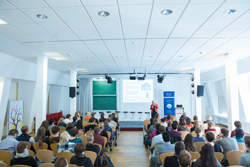 On Friday 20 October 2017, in collaboration with
 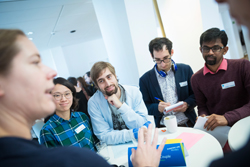 The topics at each booth ranged from how to develop effective time management strategies, or find a good job in the private sector, to the issues couples face such as finding a job in the same city, or how scientists with families achieve work-life balance at home or abroad.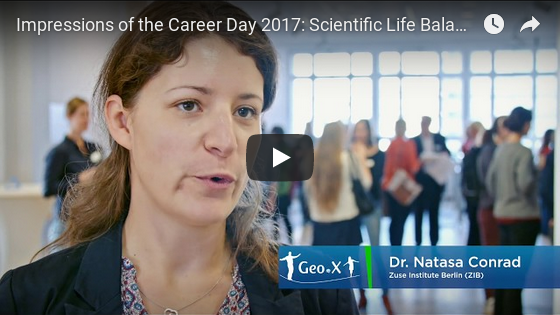
 Martin Skrodzki
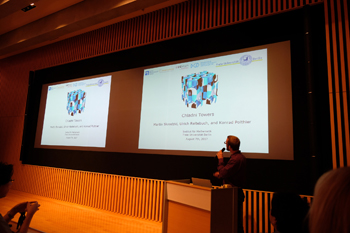 The aim of the ADMC is to encourage the creation of three-dimensional mechanisms and objects in innovative environments via 3D printing technology. The competitors were asked to submit an original design that could be created using a 3D printer. Out of 27 competitors, eleven finalists were invited to present their designs at the 2017 Asian Forum on Graphic Science in Tokyo. Upon announcing “